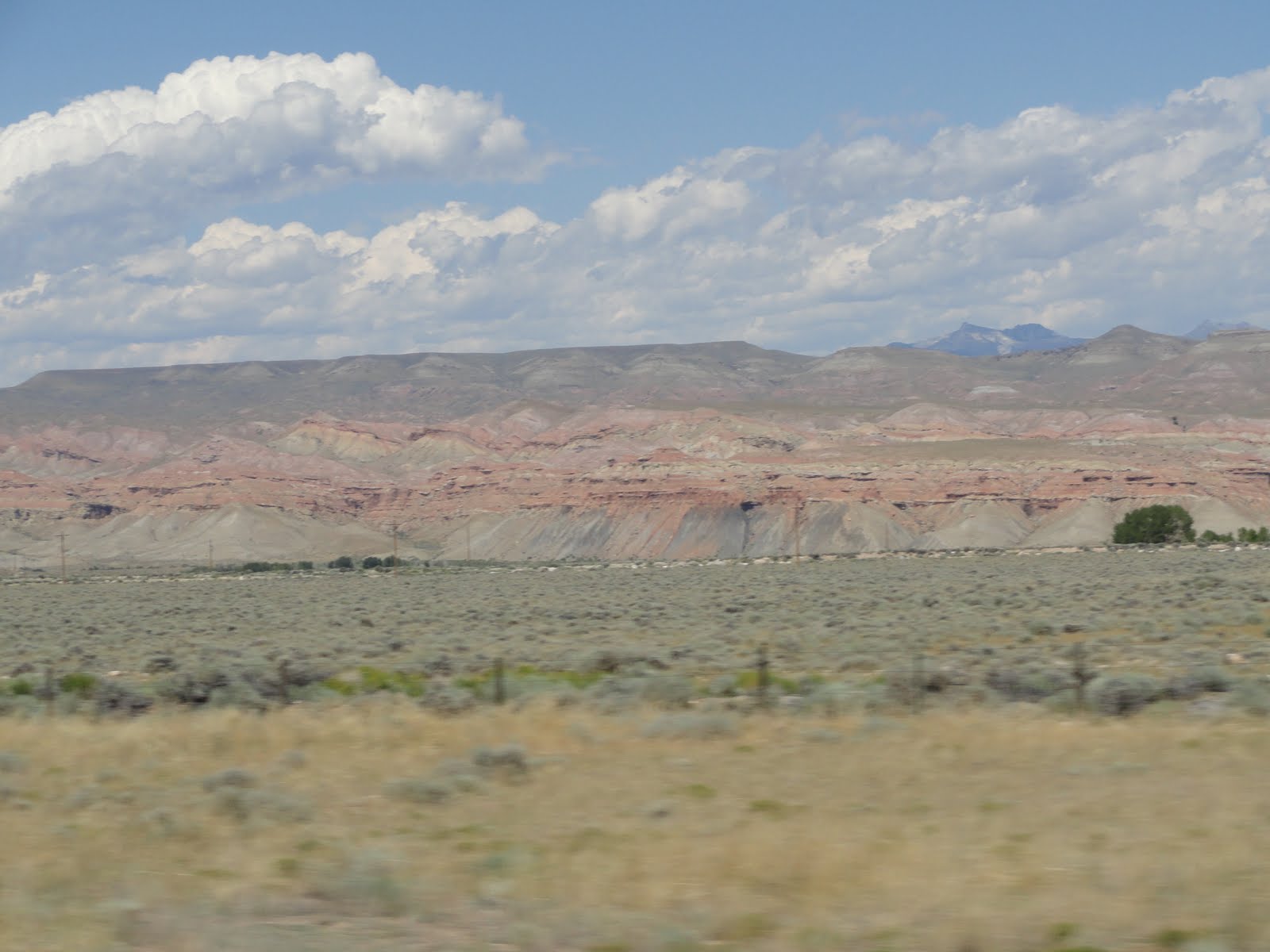
We brought the motorhome over Togwoee Pass on Friday, August 6, without any problem. The side of the road we drove on appeared smoother than even the night before.


We stopped once again at the overlook for Snake River for a photo with the motorhome and the Grand Tetons and to disconnect the car. We may send this pic to Winnebago in an attempt to seek money from them for advertising...lol.
A picture perfect moment.

The house Martin, Melissa and family live in is in the family housing area in Moose, just outside the entrance to the Teton National Park. We first set the motorhome up in their driveway, but the back was way too close to the street and we were afraid someone might come along and plow into us, although there is very little traffic. Do you see the scenery -- WOW, waking up every morning looking at that was awesome.

We then decided to move the motorhome parallel to the street in their yard, after they assured us it would be okay to have it in the yard.

Where they live reminded us of base housing -- it was even in the flight path for the Jackson Airport. We settled in, feeling right at home -- in large part due to Martin and Melissa's generosity and hospitality. One thing about being part of the Air Force family is you meet people from all over and -- for the most part -- you don't forget them when they...or you...move on. Melissa and I shared some wonderful times while they were stationed at Little Rock AFB, Arkansas. Our grandson, Allen, and our son, Jon, were living with us at the time and Nicholas and Allen would often play together. Allen turned 18 last month (July) and Nicholas is now16, but this is how they looked 10+ years ago -- I think they were adding frosting to Rachel's birthday cake -- with help from Martin.
Allen is on the left, then Nicholas and Martin.

This is Nicholas and Rachel...then

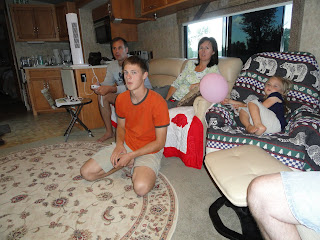
And Nicholas and Rachel today, playing Wii with Ms. Rebekah's feet hanging over the chair...lol.

This was soon after we got the motorhome set up. They did not have a Wii and were excited about playing it. And now, they have their own Wii and we would like to think we were instrumental in helping them convince Martin and Melissa to purchase Wii for them. We told them the entire family would enjoy it, but I understand the entire family pitched in to help.
And here is Allen when he visited us last summer and we toured Mark Martin's Museum in Batesville, Arkansas.

They are all grown up now.
Papa taught Nick how to throw a curve ball when bowling on Wii and Nick ended up with eight -- 8 -- strikes in a row. Rachel was the wake board champion and we had fun just watching them.
Melissa works three days a week for a Jackson attorney, but on her days off, she hung out with us...driving us here and there. One day we drove to Jackson Lake Lodge.
Awesome view from the patio


Some were waiting for the bride and groom and it was very warm in the sun.


Since we had not yet seen a bear, we took this picture...just in case. Of course, I don't think I would want to see one like this.

This table located inside the lodge was used by Secretary of State, James A. Baker, III, and Soviet Foreign Minister, Eduard Shevardnadze, to sign agreements from their productive meetings during the US-USSR Ministerial Meeting held at Jackson Lake Lodge, September 21-24, 1989, and is dubbed the "World Peace Table."


As an employee for the National Park Service, Martin has a radio that provides information, such as a "jam" and where it is located. There seemed to be a bear jam on Signal Mountain most every day, so we took a drive to Signal Mountain to see what we could see.


The valley view from top of Signal Mountain

The Indian Paint Brush is one of Melissa's favorite flowers -- it's more rampant in the Spring than in the Summer.


I personally liked this bloom -- Melissa said it was a weed...it's too beautiful to be a weed.

Mount Moran over Jackson Lake


We went to church with the family on Sunday -- the Community Bible Church.


And big 4-year-old Rebekah

Nana and Papa Mac


Mount Moran over Jackson Lake

Mt Moran dominates the northern section of the Teton Range and rises 6000 above Jackson Lake. Several active glaciers exist on the mountain with Skillet Glacier visible on the east face. In November 1950, a C-47 cargo plane owned by the "New Tribes Mission," a Christian missionary group, crashed on Mt Moran during a storm, killing all 21 on board. A rescue party located the wreckage within a few days, but the extreme location of the crash made it impossible to recover the plane or the bodies. The wreckage remains on the mountain. Among the passengers were two mothers -- who were widowed in a previous mission-owned plane crash a few months earlier -- and their children.

And driving the area behind the Oxbow Bend, we caught a glimpse of a bald eagle -- can you spot it too?


We observed a moose swimming across an area of the Snake River called the Oxbow Bend.

And driving the area behind the Oxbow Bend, we caught a glimpse of a bald eagle -- can you spot it too?

Oh Lord, Our God, how majestic is Your Name in all the earth.

While we were there, we helped celebrate Rebekah's 4th birthday. The big balloon played "Happy Birthday."

Among her gifts was a Princess (Barbie) dress.

And we shared in the feast...Rachel made the birthday cupcakes and Melissa made chicken-salad sandwiches -- YUM, YUM!!

One thing we didn't do that I wanted to do is white water rafting. It looks like it is so much fun -- we're going back and I'm going rafting -- not sure about Alan. As long as we don't turn over, I'll be good...lol.


Check out the two Osprey, sitting high and mighty in their big nest.

Osprey are sometimes known as the sea hawk or fish eagle. They are diurnal -- meaning active during the day and sleeping at night -- and are a fish-eating bird of prey. It is a large raptor, reaching 24 inches in length. It is brown on the upper-parts and predominantly grayish on the head and underparts, with a black eye-patch and wings. The Osprey tolerates a variety of habitats, nesting in any location near a body of water that provides an adequate food supply. The Osprey and Owls are the only raptors whose outer toe is reversible, allowing them to grasp their prey with two toes in front and two behind, which is helpful when they grab slippery fish.
We saw this ranch and thought perhaps it belonged to Harrison Ford, but later learned it didn't. He does have a ranch SOMEWHERE near Jackson, along with Sandra Bullock and several other stars.

We saw this mother moose with her two babies.

And a couple of elk.

We went to church with the family on Sunday -- the Community Bible Church.

And then went out for authentic Mexican food.

Crazy Nick and sweet Rachel

And big 4-year-old Rebekah

Nana and Papa Mac

We came across a moose jam. Is this crazy or what??


We did get to see a bear...he crossed right in front of us.

Later we saw another bear. This one had really long, shaggy hair -- no one had seen a bear like this one. He was busily eating something, oblivious to all the people watching him.

We visited the Visitors Center in Jackson, where there were numerous displays:


Comparing my hand to a grizzly bear track -- grrrrr.


The National Elk Refuge located in Jackson Hole was established in 1912 to provide winter habitat for approximately half of the 14,000 elk herd in Jackson. Grasslands are maintained to produce as much natural forage for elk as possible through irrigation, seeding, prescribed burning, etc. The number of elk wintering on the refuge is limited to avoid overuse of the range and to avoid the potential spread of diseases when herd animals are crowded. Elk had disappeared by 90 percent in the United States by the early 1900s. The Jackson herd was used as a nucleus herd to replenish other elk herds and elk-reintroductions across the country. The migration of the Jackson Hole herd is the longest herd migration of elk in the lower U.S. It is also the winter range for the largest bison herd (800+) in the National Wildlife Refuge System.
The elk grasslands, waiting on the elk to return for the winter.


Today the refuge is 25,000 acres and 7,000 to 10,000 elk migrate down the mountains to feed each winter. There aren't many elk to be found on the Elk Refuge outside of winter. And the few that do hang around certainly aren't visible from the highway, like they are in the winter. Needless to say, we did not see any elk...we wouldn't mind returning for a short visit in the winter just to see the migration of the elks from the mountains. However, we doubt the motorhome would be willing to make such a trip during the winter...lol.
There is a large herd of buffalo out and about, checking out all the people -- on and off the road, so be careful when visiting "their" territory.


The Gros Ventre (pronounced Grow-Vaunt) landslide is located seven miles from Jackson valley in the Gros Ventre Wilderness of Bridger-Teton National Forest.


It is believed the landslide occurred on June 23, 1925, after several weeks of heavy rain. Approximately 50 million cubic yards of sedimentary rock slid down. The landslide created a huge dam over 200 feet high and 400 yards wide across the Gros Ventre River, backing up the water and forming Lower Slide Lake.


On May 18, 1927, a portion of the landslide dam failed, resulting in a massive flood that was six feet deep for at least twenty-five miles downstream. The small town of Kelly, six miles downstream, was wiped out, killing six people. Today, the landslide is partially reclaimed by the surrounding forest.
Mormon Row may be one of the most picturesque areas of the Grand Teton National Park, with rustic wooden buildings surrounded by open fields, grass and sage standing out against the backdrop of the Tetons.


These old farm buildings have withstood the elements for more than a century -- since the farmland here was first homesteaded by the predominantly Mormon settlers in the early 1900s. We can only imagine what these early settlers thought when they reached this part of their journey and saw the magnificent Tetons. I would've said, "Let's settle here" too, especially when in the summer, the temperatures are in the 70-80s and the nights are 40s-50s -- even in the high 30s, like we experienced. Of course, I'm sure their winters were a far cry from being mild.
Across the street from where Martin and Melissa live is a path that leads to "The Chapel of Transfiguration."


"Transfiguration," is taken from the event in our Lord's earthly life, in which, during a time of prayer and meditation in the mountains, Jesus appeared to His disciples "transfigured." They saw Him no longer as a simple man, but in an intense light, they perceived a glory beyond His ordinary appearance.
Approaching the Chapel

As we entered the door of the chapel, behind the altar was this magnificent picture opportunity where you can see the Grand Tetons through the glass window. And it's already framed for you -- how awesome!

According to the information on "The Chapel of Transfiguration" -- "The name is apt because of this magnificence and grandeur, some small hint of that eternal majesty is conveyed to us who pause and, in quiet, worship. Like the disciples on the mount 2000 years ago, we would like to stay here. We cannot -- we must return to our lives -- but, like those disciples, please take away with you the vision of the power and beauty of God's presence in this world."
"And Jesus took Peter, James and John and He led them to a high mountain...
And He was transfigured before them and His garments became
radiant and exceedingly white. St. Mark 9:2-3"
How magnificent and powerful is our Lord...what a wonderful reminder in this small chapel in the middle of all the chaos and confusion we sometimes experience in this life. It is also a reminder that God is in control. I felt humbled in the small chapel as we admired God's handiwork. It was very nice to see that God has not been removed from the beauty of the Grand Tetons National Park.
Looking from the altar towards the back of the chapel.


We continued our walk through the 4LazyF Ranch -- an old ranch that is no longer in operation and now belongs to the National Park Service. It's a three-mile walk round-trip that Martin and Melissa often walk.
Along our way, we met this little guy...a Marmot.

Marmots are large ground squirrels. To us, it looked like a woodchuck or a groundhog...never in a million years would we have thought it was a ground squirrel. They typically live in burrows and hibernate through the winter. Most marmots are generally very social and use loud whistles to communicate with one another. Since then, we have learned that groundhogs are often called marmots as well.
The NPS is re-roofing the buildings on the ranch to help preserve it. This building is the kitchen where patrons of the ranch met and ate together.

That's Buddy, the family dog -- he went with us on our walk.
The path leads to Snake River and this is what we saw when we got there:
First there was one....

...then there were two.

As you can see, they didn't seem too bothered to have people so nearby.
Nana and Papa Mac with sweet Rebekah

The day before we left, we started our day with breakfast at Dornan's, a short drive from where we were parked at Martin and Melissa's.

We enjoyed two sour-dough pancakes, an egg, two strips of bacon and all the coffee, hot chocolate and orange juice we wanted...cost $6.50 as a senior.
Martin and Melissa told us about the ferry that crossed the Snake River, so following our delicious breakfast, we strolled the path to the ferry to check out the Menor's Ferry District.

Once upon a time there were two brothers -- Holliday and William (Bill) Menor. Bill Menor came to Jackson in 1892 and searched out a suitable place to build a ferry. He chose this sight where the river flowed in one channel and the approaches to its shores were not too steep. Menor's Ferry became the connecting link of life on both sides of the turbulent Snake River that divided the valley of Jackson Hole. He also built a small cabin on the west side of the river.
Holliday Menor came to Jackson Hole in 1905 and lived with his brother, Bill, until 1908. Following an argument between the two brothers, Holliday established a 160-acre homestead across the river (east side) from his brother, where he grew wheat, barley and alfalfa, which he sold to ranchers to feed their cattle during the winter. He also built a limekiln that was used several times each year to burn the limestone he quarried. Lime was important to settlers, who mixed it with sand and water to make mortar for chinking log cabins and for laying bricks and stonework. Lime was also used as a whitewash and to reduce odors in outhouses. About 250 bushels of lime, which sold for 50 cents a bushel, were produced each year.
The story goes that the two brothers used to scream obscenities to each other across the river. After several years of this, a neighbor invited each of them to his home for Christmas dinner -- not telling the brothers he had invited the other one. In the end, the two brothers reconciled. In 1918, Bill sold his property, along with the ferry, and moved to California. Holliday sold his property in 1928 and joined Bill in San Diego.
We boarded the ferry, which is a replica of the original ferry, and crossed to the west side to visit the old home place of Bill Menor. The ferry uses no motor -- only the river current propels the ferry. The ferry is secured to the cable and cannot float downstream. The Captain turns the pilot wheel in the direction the ferry needs to travel.

Arriving on the other side, we visited the cabin built by Bill Menor. We were greeted by a gentleman who told us all about the cabin. He also told us about workkamping for the National Park Service:) He is a fulltime RV'er and has been coming to this area for 32 years, not as a workkamper that long but as a visitor. He and his wife are both seasonal workers for the National Park Service.
The cabin is the original one and a wonderful asset to this area.


The stove still works and the gentleman bakes cookies for guests, but not today:(


A little girl asked Alan what this was. When he told her it was a bathroom, she wanted to know if the animals used it...lol.

This wagon was one of three that was brought into Jackson Hole over what is now known as Teton Pass in 1888.




We really enjoyed our ride on the ferry and the story of the Menor brothers, as well as exploring the original cabin of Bill Menor.
Later in the day, we came across this herd of antelope:

On our final night in the Grand Tetons the entire family came over to play Wii.

Rachel and her friend.


Silly Nick

We were up early Friday morning preparing to once again "hit the road." We can never thank Martin and Melissa enough for their kindness, generosity, hospitality, etc. As I've said before -- they wrote the definition for hospitality. I'm sure if you look up the word in the dictionary, you will see their faces. Although Melissa worked three days, she made dinner every night. And Rachel always helped her mom -- without even being asked. They wouldn't let us take them out to eat or anything -- she informed me they fed their visitors. We appreciate everything they did for us while we were there. We left some things to do so we will have an excuse to come back -- rafting, rodeo, Bar J Chuckwagon. If we never make it back to Moose, Wyoming, we will always remember Martin, Melissa, Nicholas, Rachel and Rebekah. They are a wonderful Christian family, who we are proud to call friends.
May God continue to bless this awesome family and may God bless our voyage, as well as our family and friends everywhere.
Thank you, my friend!